ARTICLES
Top 10 Employee Well-being Platforms in 2026
Explore the top 10 employee well-being platforms in 2026 and see how organizations are improving well-being at work with smarter, integrated...
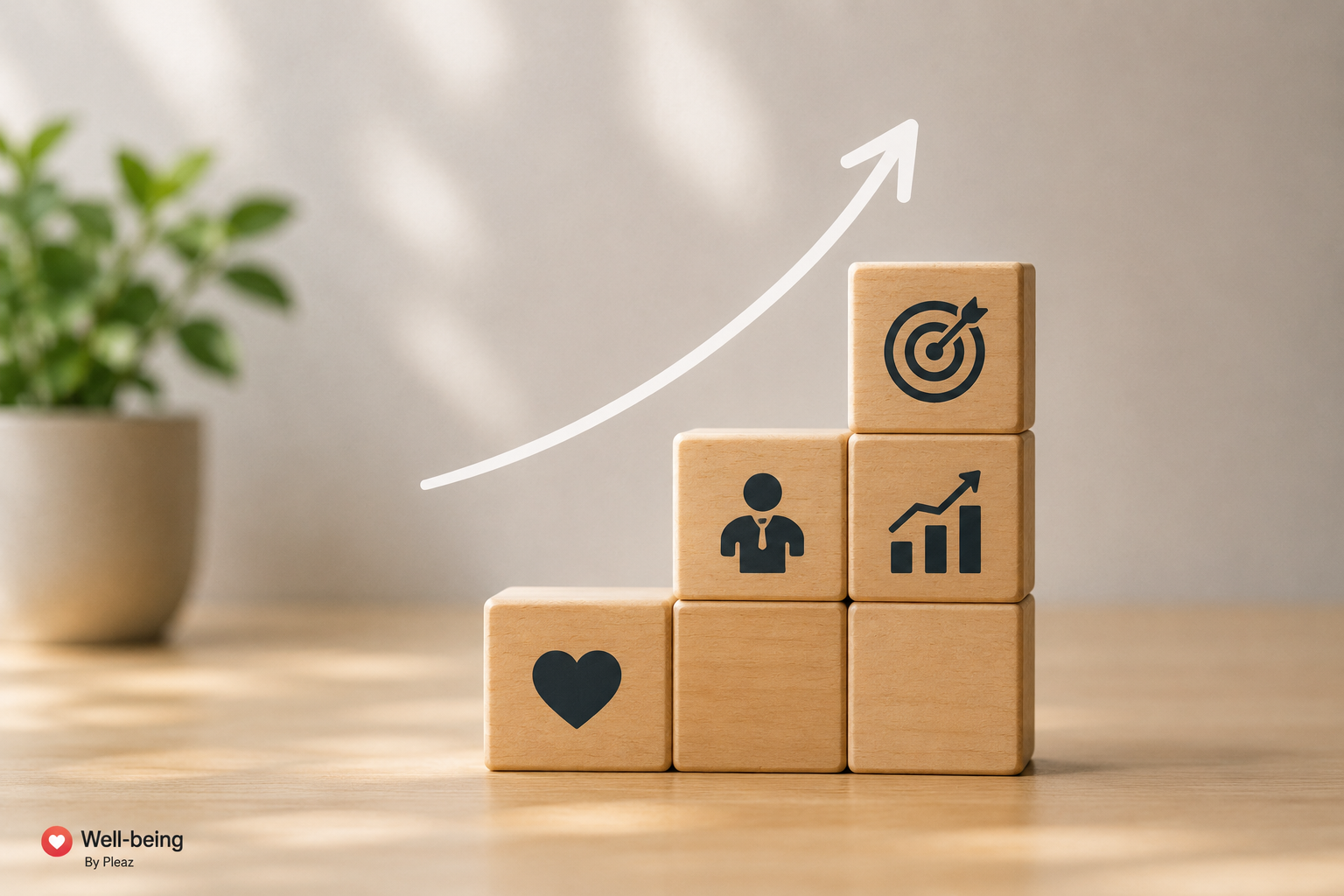
Summary: Employee well-being has evolved from an HR talking point into a business performance strategy.
Organizations are increasing investments in workplace well-being platforms to improve engagement, reduce stress, and attract and retain talent.
Yet many leaders now expect more than positive sentiment. They want clear, measurable ROI. The discussion has shifted from whether well-being matters to how it creates value.
While research shows a strong correlation between well-being and performance, ROI often depends on one simple factor: whether employees actually use the tools provided. The highest-performing organizations are moving away from 'destination' apps toward workflow-integrated solutions. ROI is now driven by one factor: eliminating the friction between working and recovering.
TABLE OF CONTENTS
WHAT ROI IN EMPLOYEE WELL-BEING MEANS
THE COST OF POOR WELL-BEING
WHAT THE RESEARCH SHOWS
WHERE COMPANIES STRUGGLE
HOW TO IMPROVE WELL-BEING AT WORK
HOW PLEAZ APPROACHES ROI
WHAT IS CHANGING IN THE WORKPLACE
BOTTOM LINE
ROI in employee well-being cannot be captured by a single metric. It accumulates across engagement, performance, absenteeism, and retention.
Research published in PubMed on workplace wellbeing and organizational performance highlights the strong relationship between employee wellbeing, productivity, engagement, and organizational outcomes.
At the same time, Deloitte’s mental health ROI analysis found that organizations investing in mental health and workplace wellbeing initiatives can see measurable returns through improved productivity, reduced absenteeism, and stronger employee retention.
The takeaway is clear: Wellbeing ROI isn't a one-time gain; it’s a performance multiplier. By reducing 'presenteeism' (being at work but not functioning), companies unlock hidden capacity in their existing workforce.
The economic impact of low wellbeing is significant.
The World Health Organization’s Mental Health at Work report estimates that depression and anxiety cost the global economy approximately $1 trillion annually in lost productivity.
According to Gallup’s State of the Global Workplace report, low employee engagement costs the global economy around $8.9 trillion each year, representing roughly 9 percent of global GDP.
Research from Great Place to Work’s analysis of workplace wellness ROI also highlights the connection between burnout, turnover, and organizational performance.
Ignoring employee wellbeing quietly affects performance, morale, collaboration, and retention across the organization.
Research consistently supports the connection between employee wellbeing and business performance.
Research published in PubMed on workplace wellbeing and organizational performance highlights the strong relationship between employee wellbeing, productivity, engagement, and organizational outcomes.
At the same time, Deloitte’s mental health ROI analysis found that organizations investing in mental health and workplace wellbeing initiatives can see measurable returns through improved productivity, reduced absenteeism, and stronger employee retention.
Research connected to workplace recovery and active breaks has also shown measurable wellbeing outcomes.
Research from the University of Copenhagen on active breaks and workplace wellbeing found that short active recovery moments can help reduce stress and improve employee wellbeing throughout the workday.
At the same time, research published in Nature Scientific Reports on micro-exercise and long-term sickness absence found that workplace micro-exercises may help reduce long-term sickness absence while supporting healthier and more sustainable work habits over time.
The evidence increasingly points in the same direction: wellbeing becomes more valuable when it is consistent, accessible, and integrated into how employees already work.
Many organizations fail to realize these returns because participation remains inconsistent.
Traditional programs suffer from the 'Toggle Tax', the mental energy lost when employees must switch between work tools and separate wellness portals. This friction is the primary reason for low participation. If a tool isn't where the work happens, it effectively doesn't exist for the employee.
This creates friction.
Even when organizations invest heavily in workplace wellness initiatives, employees may struggle to participate consistently enough for meaningful behavioral change to happen.
This has led many organizations to rethink not only whether they invest in well-being, but also how well-being is delivered and sustained over time.
To create measurable ROI, wellbeing needs to fit naturally into the workday rather than exist as something extra employees are expected to remember.
Organizations with strong well-being outcomes often follow several common principles.
They integrate well-being into existing workflows rather than relying on separate platforms.
They focus on short, repeatable actions that employees can realistically maintain throughout the workday.
They encourage shared participation and team-level engagement instead of treating well-being as an individual responsibility alone.
They measure progress consistently using metrics connected to engagement, retention, absenteeism, and employee experience.
Most importantly, they reduce friction wherever possible. The easier well-being is to access, the more likely employees are to participate consistently over time.
Quick Wins Organizations Can Implement
Small, repeatable actions often create a stronger long-term impact than occasional large initiatives.
One of the biggest challenges in workplace wellbeing is maintaining consistent participation over time.
Even strong well-being initiatives often struggle to create a measurable impact when employees rarely engage with them during busy workdays.
Pleaz approaches this differently by integrating well-being directly into Microsoft Teams, where employees already communicate and collaborate throughout the day.
As a Well-being Platform integrated into Teams, Pleaz helps organizations make wellbeing easier to access naturally within everyday workflows rather than through separate platforms or additional routines.
Employees can participate individually or together as teams in experiences such as:
This workflow-based approach helps support more consistent participation and ongoing engagement over time.
Research connected to micro-breaks and workplace recovery has also shown measurable well-being outcomes.
Research from the University of Copenhagen on active breaks and workplace well-being found that short active recovery moments can help reduce stress and improve employee well-being throughout the workday.
At the same time, research published in Nature Scientific Reports on micro-exercise and long-term sickness absence found that workplace micro-exercises may help reduce long-term sickness absence while supporting healthier and more sustainable work habits over time.
Rather than positioning well-being as a separate activity outside work, Pleaz helps organizations integrate well-being directly into everyday collaboration and team routines.
The future of workplace wellbeing is becoming increasingly integrated, measurable, and continuous.
Organizations are moving away from standalone wellness initiatives and toward solutions that fit naturally into daily collaboration tools and workflows.
At the same time, HR and leadership teams are increasingly aligning well-being metrics with broader business KPIs, such as:
This reflects a growing understanding that well-being is directly connected to sustainable organizational performance.
Employee well-being creates measurable business value when employees can engage with it consistently over time.
Research increasingly shows that organizations see stronger outcomes when well-being is integrated naturally into everyday workflows rather than delivered through isolated initiatives or standalone platforms.
As work becomes more digital and cognitively demanding, participation, accessibility, and sustainability are becoming critical factors influencing well-being ROI. Organizations that reduce friction and support well-being directly within collaboration environments are more likely to improve engagement, retention, recovery, productivity, and long-term employee performance.
As a Well-being Platform integrated directly into Microsoft Teams, Pleaz helps organizations support stress reduction, movement, recovery, pain prevention, and team well-being naturally throughout the workday.
The future of workplace well-being is becoming increasingly measurable, integrated, and connected to how employees already work every day.
Explore the top 10 employee well-being platforms in 2026 and see how organizations are improving well-being at work with smarter, integrated...
Learn how to engage employees in the workplace with proven, research-backed strategies that improve connection, motivation, and well-being in...
Leadership behavior shapes workplace culture, trust, and wellbeing. Learn why leaders play a critical role in long-term employee wellbeing.